Ni - Labs :

Research ( Virtual Reality (VR) | Hand Tracking | Biosignal )
研究 ( 仮想現実 | ハンドトラッキング | 生体信号 )
研究 ( 虚拟现实 | 手部追踪 | 生理信号 )


Catalog  |  カタログ  |  目录

- (English) Changes in Motor Performance and Physiological Signals under VR-Based Alcohol Effect Simulation
- (日本語) VRアルコール影響のシミュレーションにおける動作および生体信号の評価
- (中文) 在VR醉酒模拟下的动作和生理信号的变化研究


(English)
Changes in Motor Performance and Physiological Signals under VR-Based Alcohol Effect Simulation

1. Background
Immersive technologies can potentially improve personal health with realistic environment simulation. For example, using VR to reduce stress, support physical rehabilitation, improve attention recovery. Additionally simulating disease symptoms, to raise public awareness and empathy [1].
 In this research, we build a VR experience that improves people’s perception of personal health. One of the applications is understanding the impact of alcohol consumption [2] on vision impairment, motor coordination [3], and cognitive impact. Studies show that even moderate drinking can lead to color vision loss, reduce attention awareness, and long-term visual damage . Motor coordination impairment may persist even after sobriety. However, most existing simulations mainly focus on simulating vision impairment and drunk driving. This study proposes to combine multi-sensory (vision, hearing) and motor impairments to raise awareness of alcohol's impact on perceived health.
 This research aims to: Improve understanding of alcohol’s effects on vision, hearing, and motor coordination using VR simulation.

2. VR Simulation
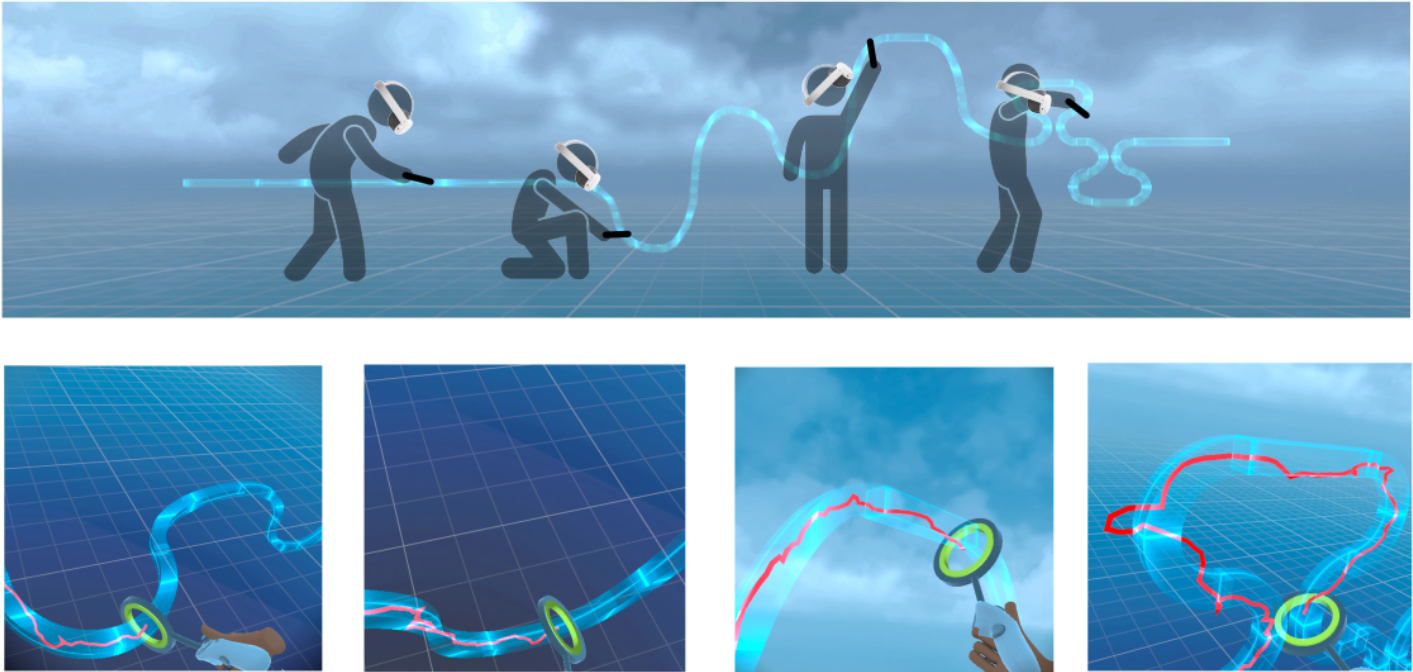
In VR, the task requires the user to use a VR controller holding a virtual stick and pass through a virtual wire.If the stick touches the wire, it will be considered a fault. The aim of the game is to complete the path without touching the wire. During the task, the user performs actions such as walking, bending, squatting, and stretching to complete the task. The purpose of this is to enhance their awareness of how alcohol affects physical balance.
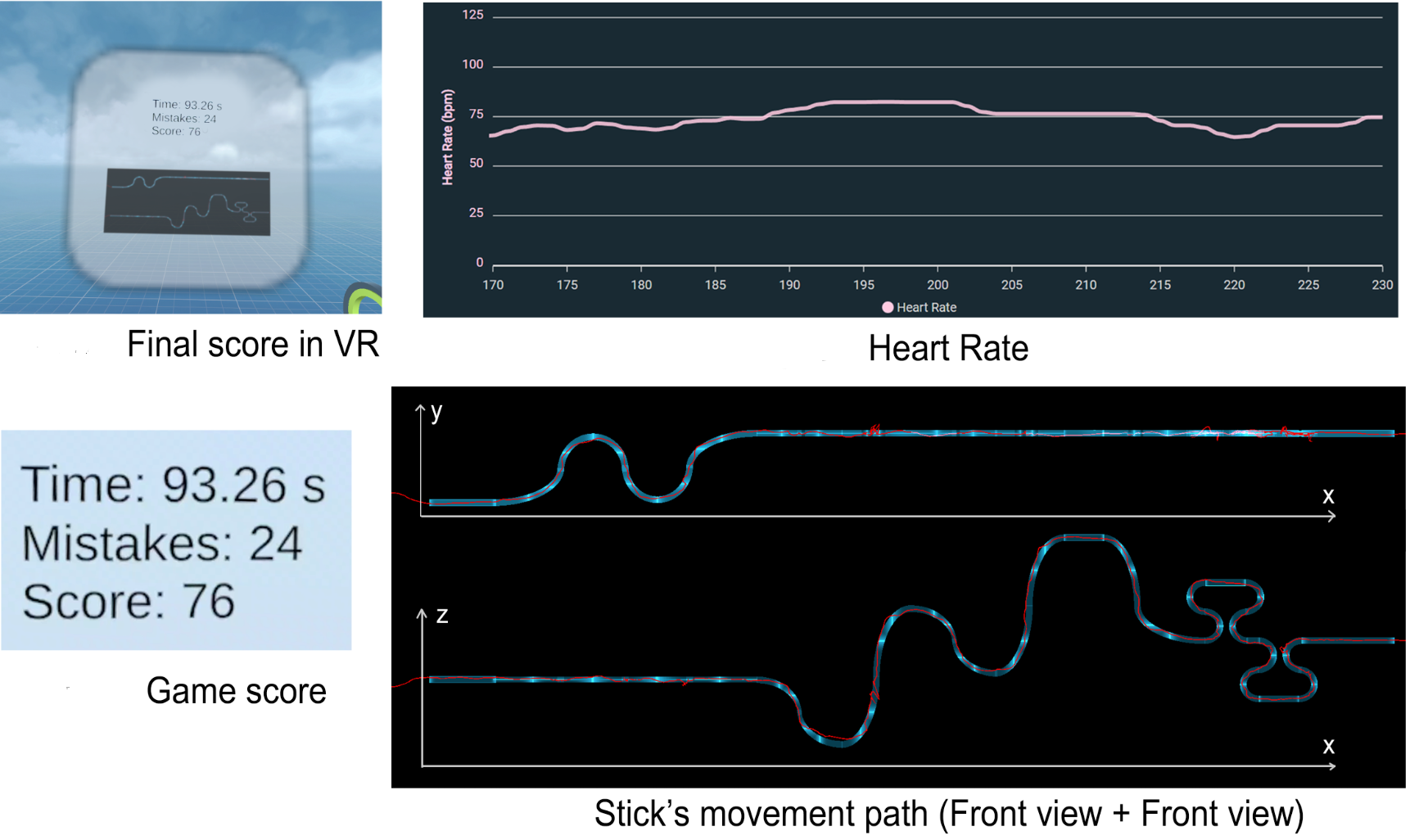
 If the stick touches the wire, a warning sound will be triggered and 1 point will be deducted from the total score (100 points in start). If the stick remains in touch with the wire, additional 1 point will be deducted per second. The game ends when the stick passes through the wire, final score and the stick’s movement path will be displayed. The aim of the game is to complete the path with as few touches as possible.


We simulate the effect of alcohol in three levels:
L1) Visual effect: blur + camera shake
L2) Audio effect: noise + heartbeat sound
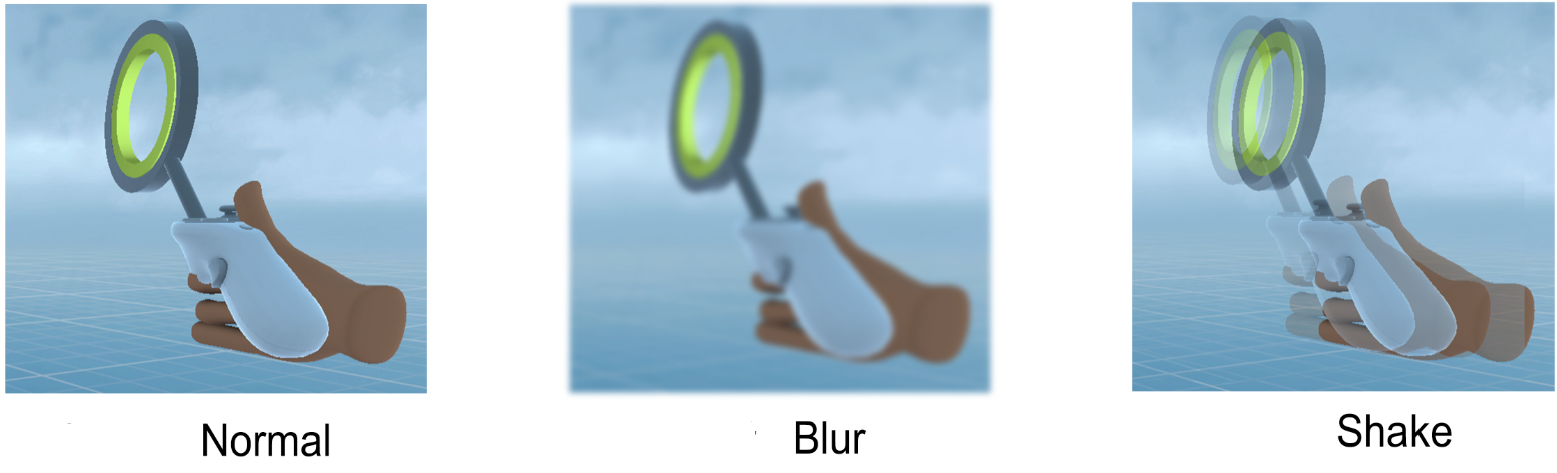
L3) Controller effect: shake + delayed response


3. User Study Evaluation
Research questions:
RQ1: How does VR simulated alcohol intoxication affect perceived personal health?
RQ2: In VR simulated alcohol intoxication If the human body exhibits physiological responses similar to real alcohol intoxication?
Hypotheses:
We expect that increasing the level of alcohol simulation will lead to lower task accuracy, longer completion time, and higher workload and stress scores.
H1A: task accuracy will be lower in visual effect comparing to baseline
H1B: completion time will be lower in visual effect comparing to baseline
H1C: task workload will be higher in visual effect comparing to baseline
H1D: stress will be higher in visual effect comparing to baseline
H2A: task accuracy will be lower in visual+audio effect comparing to visual only
H2B: completion time will be lower in visual+audio effect comparing to visual only
H2C: task workload will be higher in visual+audio effect comparing to visual only
H2D: stress will be higher in visual+audio effect comparing to visual only


Independent Variables - Conditions:
C1) Baseline – no alcohol simulation
C2) Low level – visual effect only
C3) Medium level – visual + audio + control effects
Objective measures:
M1) accuracy (number of times touching the wire)
M2) time completion of the path
M3) heart rate
Subjective measures:
M4) NASA TLX questionnaire
M5) STAI6 questionnaire
M6) Virtual Embodiment Questionnaire (VEQ)
M7) Alcohol Awareness Questionnaire
Expected Contributions
1) VR application to to simulate alcohol effects
2) User study evaluation validating the VR application

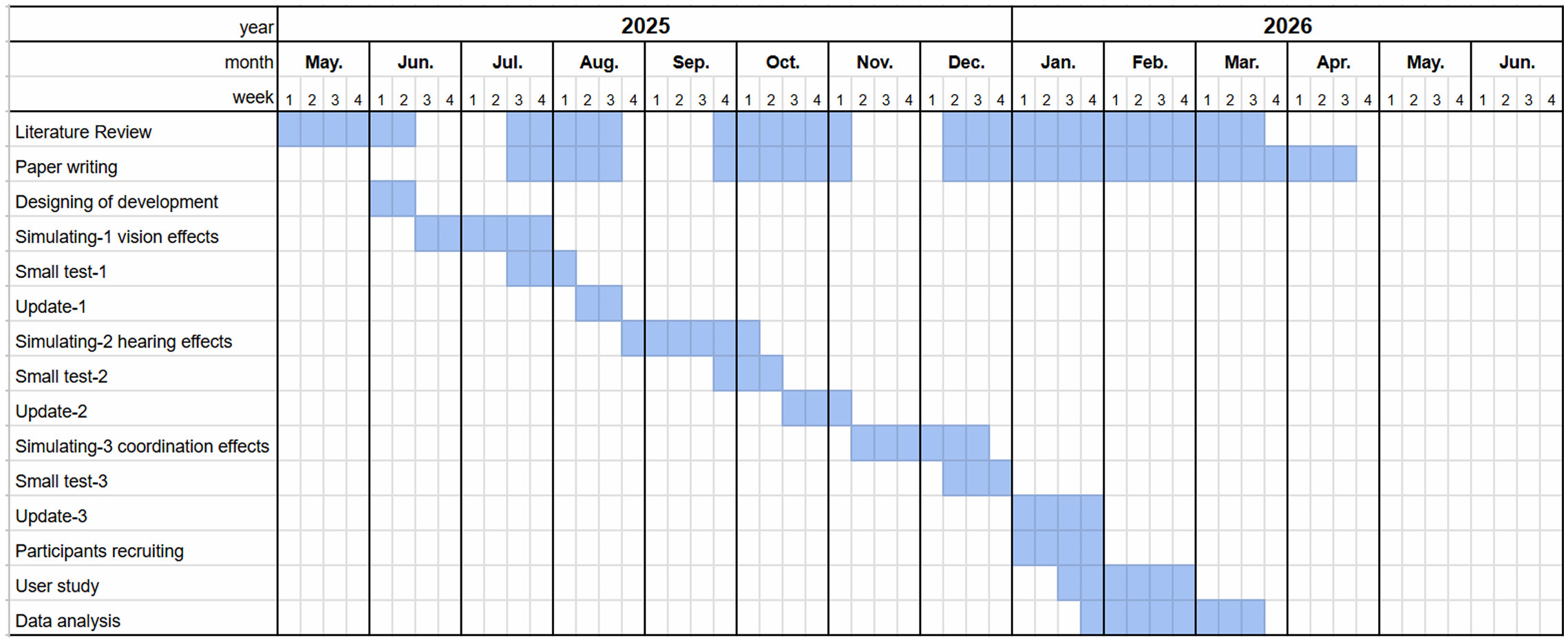
4. Schedule


5. App
Quest 3 [ ver0629-31.apk ] (NEW)
Quest 3 [ ver0625-30.apk ]
Quest 3 [ ver0618-29.apk ]

(日本語)
VRアルコール影響のシミュレーションにおける動作および生体信号の評価/span>

1. 背景
近年、没入型技術は、現実に近い環境を再現することで、個人の健康を向上させる可能性があるとされています。例えば、VR を用いたストレス軽減、身体リハビリの支援、注意力回復の促進、さらには疾病症状の再現による啓発や共感の向上などが挙げられます [1]。
 本研究では、VR 体験を通して自己の健康に対する認知を高めることを目的としています。その応用例として、アルコール摂取が視覚障害、運動協調、認知機能に与える影響 [2][3] を理解してもらうことを目指します。先行研究では、少量の飲酒でも色覚低下、注意力の低下、長期的な視覚障害が発生し得ること、また運動協調の低下は酔いが覚めた後も残存する可能性が示されています。しかし、既存の多くのシミュレーションは視覚障害や飲酒運転の再現に偏っています。本研究では、視覚・聴覚・運動の複合的な感覚障害を組み合わせ、アルコールが身体認知に与える影響についてより深い理解を促すことを提案します。
 研究目的:VR シミュレーションを用いて、アルコールが視覚・聴覚・運動協調に与える影響の理解を高めること。

2. VR シミュレーション
VR 内の課題では、ユーザは VR コントローラで仮想のスティックを操作し、ワイヤー状のコースを触れずに通過させます。スティックがワイヤーに触れるとミスとなります。目標は、できるだけ触れずにコースを完走することです。 課題中、ユーザは歩行、前屈、しゃがむ、体を伸ばすなどの動作を行います。これにより、アルコールが身体のバランスや動作に与える影響を自覚しやすくなります。
 スティックがワイヤーに触れると警告音が鳴り、初期得点 100 点から 1 点が減点されます。触れ続けた場合は、1 秒ごとに追加で 1 点減点されます。コースを完走するとゲームが終了し、最終スコアとスティックの軌跡が表示されます。


アルコール影響のレベル設定
L1:視覚効果(ブラー + カメラシェイク)
L2:聴覚効果(ノイズ + 心拍音)
L3:コントローラ効果(振動 + 入力遅延)


3. ユーザスタディ評価
研究質問
RQ1: VR による飲酒状態の再現は、個人の健康認知にどのような影響を与えるか?
RQ2: VR 上での酩酊状態は、実際の飲酒に類似した生理的反応を引き起こすか?
仮説
アルコールシミュレーションのレベルが上がるほど、 正確性は低下し、タスク時間は増加し、ワークロードとストレスは上昇すると予測しています。
H1A–H1D: 低レベル(視覚のみ)はベースラインよりも正確性低下、時間増加、ワークロード増加、ストレス増加を引き起こす
H2A–H2D: 中レベル(視覚+聴覚+操作遅延)は視覚のみよりさらに悪化する


独立変数(条件)
C1: ベースライン(アルコール効果なし)
C2: 低レベル(視覚効果のみ)
C3: 中レベル(視覚+聴覚+操作効果の複合)
客観的指標
M1: 正確性(接触回数)
M2: コース完了時間
M3: 心拍数
主観的指標
M4: NASA-TLX
M5: STAI-6
M6: Virtual Embodiment Questionnaire(VEQ)
M7: アルコール認知アンケート
期待される貢献
アルコール影響を再現する VR アプリケーションの開発
ユーザスタディによるその有効性の検証

4. 日程


5. アプリ
Quest 3 [ ver0629-31.apk ] (NEW)
Quest 3 [ ver0625-30.apk ]
Quest 3 [ ver0618-29.apk ]

(中文)
在VR醉酒模拟下的动作和生理信号的变化

1. 背景
沉浸式技术可以通过逼真的环境模拟来提升个人健康。例如,使用 VR 来减轻压力、支持身体康复、改善注意力恢复,以及通过模拟疾病症状来提升公众意识和共情能力 [1]。
 在本研究中,我们构建了一种能够提升人们健康认知的 VR 体验。其中一个应用场景,是帮助人们理解酒精摄入 [2] 对视觉损伤、运动协调能力 [3] 以及认知功能的影响。研究表明,即使是适量饮酒,也可能导致色觉丧失、注意力下降以及长期的视力损伤。运动协调能力的损害甚至可能在酒醒之后仍然持续。 然而,现有的大多数模拟主要集中在视觉损伤和酒后驾驶的情景上。本研究提出结合多感官(视觉、听觉)以及运动功能受损的表现,以提升人们对酒精对健康影响的认知。
 本研究的目标是: 通过 VR 模拟,提高对酒精对视觉、听觉及运动协调影响的理解。

2. VR 模拟
在 VR 中,任务要求用户使用 VR 控制器握住虚拟探针,并沿虚拟电线前进。如果探针碰到电线,则被视为一次失误。游戏的目标是在不触碰电线的情况下完成整条路径。在任务过程中,用户需要进行走路、弯腰、下蹲、伸展等动作,以此来增强他们对酒精对身体平衡影响的意识。
 如果探针触碰到电线,将触发警告声音,并从总分中扣除 1 分(初始分数为 100 分)。如果探针持续接触电线,则每秒额外再扣 1 分。当探针成功通过电线后,游戏结束,并显示最终得分以及探针的运动轨迹。游戏的目标是尽可能减少触碰电线的次数。


我们将酒精效果分为三个等级进行模拟:
L1) 视觉效果:画面模糊 + 视角晃动
L2) 听觉效果:噪声 + 心跳声
L3) 控制器效果:震动 + 延迟反应


3. 用户研究评估
研究问题:
RQ1: VR 中模拟的酒精醉酒状态会如何影响个体对自身健康的主观认知?
RQ2: 在 VR 模拟酒精醉酒的情况下,人体是否会表现出与真实醉酒相似的生理反应?
研究假设:
我们预期,提高酒精模拟的等级会导致任务准确率下降、完成时间延长,以及工作负荷和压力评分上升。
H1A:与基线相比,在仅视觉效果条件下任务准确率会更低
H1B:与基线相比,在仅视觉效果条件下任务完成时间会更长
H1C:与基线相比,在仅视觉效果条件下任务工作负荷会更高
H1D:与基线相比,在仅视觉效果条件下压力水平会更高
H2A:与仅视觉效果相比,在视觉+听觉条件下任务准确率会更低
H2B:与仅视觉效果相比,在视觉+听觉条件下任务完成时间会更长
H2C:与仅视觉效果相比,在视觉+听觉条件下任务工作负荷会更高
H2D:与仅视觉效果相比,在视觉+听觉条件下压力水平会更高


自变量 - 条件:
C1) 基线条件 – 无酒精模拟
C2) 低等级 – 仅视觉效果
C3) 中等级 – 视觉 + 听觉 + 控制效果
客观指标:
M1) 准确率(探针触碰电线的次数)
M2) 完成整条路径所用时间
M3) 心率
主观指标:
M4) NASA TLX 问卷
M5) STAI6 问卷
M6) 虚拟具身化问卷(VEQ)
M7) 酒精认知问卷
预期贡献:
1) 一个用于模拟酒精影响的 VR 应用
2) 通过用户研究评估,对该 VR 应用进行验证

4. 日程


5. 应用程序
Quest 3 [ ver0629-31.apk ](最新)
Quest 3 [ ver0625-30.apk ]
Quest 3 [ ver0618-29.apk ]

View Details

Research (VR | Hand Tracking | Biosignal)

研究 (仮想現実 | ハンドトラッキング | 生体信号)
研究 (虚拟现实 | 手部追踪 | 生理信号)

View Details

Project (Computer Vision | MR Driving)

プロジェクト (画像認識 | 複合現実ドライビング)
项目 (图像识别 | 混合现实模拟驾驶)

View Details

Development (Web | Server | Database)

開発 (ウェブサイト | サーバ | データベース)
开发 (网站 | 服务器 | 数据库)

View Details

Programming (Scripts | Mini Game)

プログラミング (スクリプト | ミニゲーム)
程序 (脚本 | 小游戏)

View Details

Product Design (3DCAD | 3Dprint | Modeling Rendering)

製品設計 (3DCAD | 3Dプリント | モデリング,レンダリング)
产品设计 (3DCAD | 3D打印 | 建模渲染)

View Details

Law (Ai / Autonomous Driving Accidents | Product Liability)

法律 (Ai / 自動運転事故民事責任 | 製造物責任)
法律 (Ai / 自动驾驶事故民事责任 | 产品责任)

Get In Touch / 連絡

Thank you for visiting!
ご覧いただきありがとうございます!